|
|
|
This page last updated October 22nd, 2026. |
|

 |
|
gen
V
16"
f3.5 Dream Hypergraph |
|
fully corrected & optimized
(no vignetting) for a 55mm focal plane diameter and small pixels |
|
|
|
|
This
paper compares the installed performance efficiency of one
original gen I 16" f3.75 Dream Astrograph telescope compared
to four 18" f2.8 prime focus telescopes. The new gen V Dream
Hypergraph will be substantially higher in quality and installed
performance compared to the gen I. |
|
|
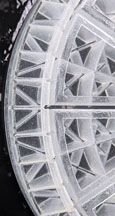
This
paper illustrates why Dream's 20+ years of engineering
lightweight mirrors is so valuable. |
|
|
|
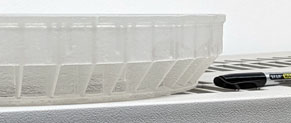
Dream will no longer
offer different options in this aperture, so we can focus on
the new gen V 16" f3.5 Dream Hypergraph. |
The
only athermal
instruments
in the world that use such a high percentage of carbon fiber
supporting structures
(95% of
the telescope weight without optics). These
cutting edge low-mass, high stiffness athermal structures are
mated with Dream's highly engineered, thin-featured lightweight
zeroDELTA™
mirrors,
which have no
print through.
The entire system is optimized from the ground up for remote/robotic
use and the highest installed performance, eliminating
countless areas of performance loss. Dream's technologies have unrivaled
consistent, long-term installed
performance
and the lowest possible maintenance. |

 |
|
|
|
|
IMX461 CMOS: 3.76µm pixels, 11656
x 8742, 55mm image circle. |
|
Field Of View (f3.5): 79.3' x 105.6' (2.326
deg²) |
|
Arc-seconds/pixel: 0.54 |
|
|
 |
|
|
OTA diameter - OD |
length |
focal length |
|
CFSC™ HybridTube™: 20.0" |
~60" |
1422mm - f3.5 |
|
|
|
|
|
|
|
|
|
|
|
|
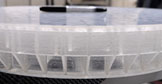
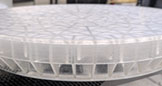
lightweight secondary mirror |
weight - pounds |
single unit pricing |
|
6" (36.5% central obscuration) |
~65-70 |
contact Dream |
|
100% illumination
of 55mm image circle. No vignetting from secondary mirror or
the corrector. |
this weight includes
focus, the new large corrector and FAST. |
clamshell rings are not required for
mounting, only a dovetail plate |
|
|
|
|
|
|
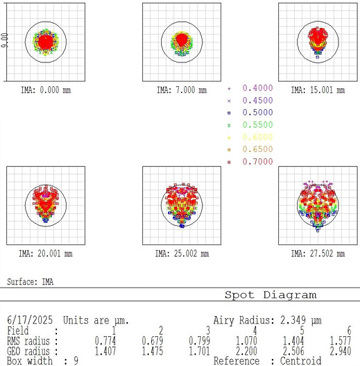
The new gen V 16" f3.5 Dream Hypergraph
has unrivaled optical design performance. Dream spent three years
refining this optical design to be at the leading edge. Because
the performance can't be improved upon, it will allow Dream to
focus on this model long into the future. To learn more about
understanding a spot diagram, please read Shane's published
article from the January, 2024 issue of Laser Focus World. |
|
O |
|
The gen V system has the same 82mm of back
focus as our original 16" f3.75 Dream Astrograph. |
|
|
|
The gen V uses the same telescope tube,
the same spider assembly, the same secondary mirror support and
the same thin-featured lightweight zeroDELTA™
secondary mirror as the original 16"
f3.75 Dream Astrograph. |
|
|
|
There is no vignetting from either the
corrector or the secondary mirror on this telescope, even when
using a IMX461 detector (55mm diameter focal plane). The gen
V telescope has less vignetting than the original, slower telescope
because the gen V corrector is shorter. |
|
|
|
|
|
|
|
|
|
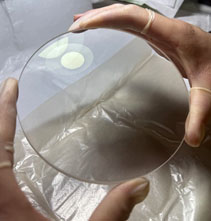
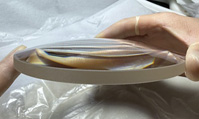
May 12th, 2026: The first batch of corrective lenses (the
finished and coated lenses themselves) are now finished. The
largest diameter corrective lens is shown to the left and right.
As of July 20th,
2026 the titanium housing has been started at the machine
shop. |
|
O |
|
Dream continues to work on the main structures
(see photos further down on this page), including the most complex
and precise portion of the puzzle: additional lightweight
primary mirrors, finished using our 4D Technology PhaseCam
6010 dynamic interferometer. This is the same technology
used to test the James Webb Space Telescope mirrors. |
|
 |
|
|
|
|
|
|
|
 |
|
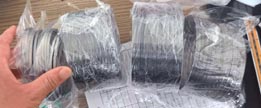
August 19th, 2026 - The large titanium barrels
and internal parts are finally finished! They'll be sent for
coating before the end of August, 2026. Then the lenses will
be installed and the correctors will finally (finally...) come
together. |
|
O |
|
September 7th, 2026 -
Another critical milestone was achieved. One uncoated full housing
was tested with the lenses in the first week of September 2026.
Everything fit, so that housing was then sent back so all 10
housings & internals can be coated. |
|
 |
|
|
|
|
|
|
|
|
|
|
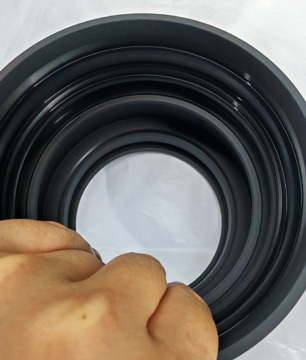
October 22nd, 2026
- The first large titanium barrel and internals was flat black
coated alone, as a test, which was successful. The first 5"
corrector is being assembled right now and will come to Dream
first, before the rest of the batch.
The other nine housings should finish with coating within
the next week, then will go to the lens manufacturer to be assembled. |
|
|
|
|
|
|
 |
|
|
|
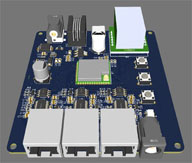
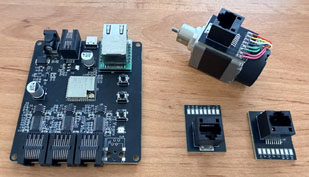
June 1st, 2026: Martin
received the first few PCB boards he designed for the new Dream
controller. He's wired up one of the precision linear actuators
and its dedicated absolute encoder, as shown left. |
|
|
 |
|
|
|
|
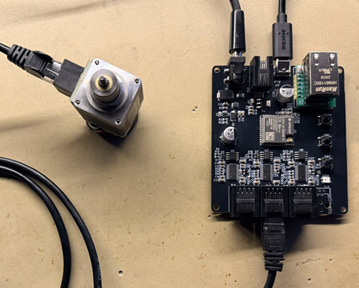
June 4th, 2026: Martin
tested the new control board with one precision linear actuators.
He tested all three actuator ports, verifying they work properly.
Martin previously tested one actuator, receiving data from the
encoder at a rate of ~14K/sec, which will never be needed for
our purposes. |
|
|
|
The PCB controller board will
control each actuator and receive data from each absolute encoder.
This system is ASCOM/ ALPACA-compliant so the user can control
focus on the gen IV (2 units) and gen V (future units) telescopes.
The board also provides power for the fans on the back of each
Dream telescope. |
|
|
|
|
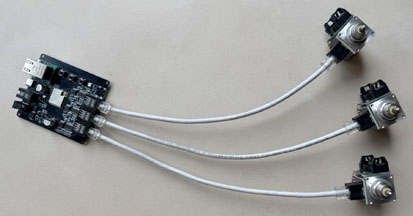
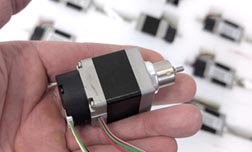
July 6th, 2026 - Martin received
the other two actuators, giving him three to try out a full system's
worth of actuators. He wired all three and tested them. Everything
is working as planned.
Each precision linear actuator has an absolute encoder and
a small battery backup. If both power and the firmware fail,
position data for each actuator will be maintained.
August 4th, 2026: Martin has
finished all work - The ASCOM & ALPACA drivers are finished
& working properly. The internal configuration software that
Dream will use to both calibrate each actuator's actual movements
(using a SICK sensor with 20nm resolution) and set limits that
users cannot exceed - safe limits. He previously finished the
software portion that allows end-users to adjust: focus, and
tip/tilt of the primary mirror. |
|
 |
|
|
|
|
|
 |
|
|
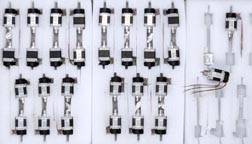
Dream
receives the 30 precision linear actuators on July 3rd, 2026. |
|
O |
 |
|
|
 |
|
|
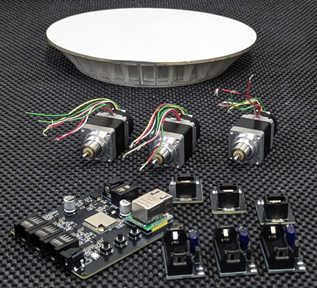
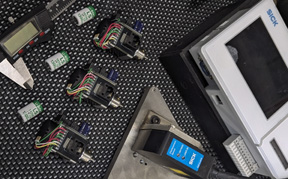
September 29th, 2026 - Dream
receives the first control board and accessories from Martin.
Shown above with three precision linear actuators and a coated
6" zeroDELTA™ lightweight secondary mirror. |
|
 ss ss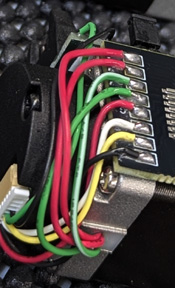 |
|
|
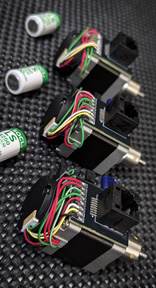
October 22nd, 2026
- Dream
attaches the boards to the actuators, then solders all of the
28 gauge wires. Attachment and soldering were not work Dream
expected to be doing, but Martin's schedule is too full right
now. |
|
|
 |
|
October 22nd, 2026
- The next step is to take a
SICK non-contact laser sensor to quantify the travel of each
actuator. This data is input into the firmware of the control
board for these three actuators. These "lookup tables"
for each actuator will provide even more accurate movement.
The SICK sensor has a resolution
of 20nm and the actuators move at 1.6 microns per full revolution
of the motor. The actuators do not require power to hold a position
and they use very low power when they are needed for a move.
There will be no heat from these actuators because of these factors,
which is important because they are positioned in the back of
the telescope, near the primary mirror. |
|
|
|
A detailed document about this gen
V optical design/instrument can be viewed
here. |
|
|
|
|
|
Click
here to watch a video
showing the scale of Dream's in-house figuring work to the first
zeroDELTA™
lightweight primary mirror for
this gen V telescope. |
|
The first graphic below left is PhaseCam
data detailed in this
video on Dream's
YouTube channel. That u28 lightweight mirror was the first
primary mirror finished for the gen V telescope. The Dream 16"
zeroDELTA™
primary mirror is the only thin-featured, highly engineered,
truly lightweight mirror with no print through on the
market. It's 5-6 times lower in aerial density than the Hubble
Space Telescope's lightweight primary mirror. No feature, including
the face, is thicker than 3.2mm, on either the primary mirror
or secondary mirror. The highly engineered zeroDELTA™
lightweight mirrors equalize faster than any other mirrors on
the open market, which is one of many features that give Dream's
telescopes their unbeatable installed performance. |
|
|
|
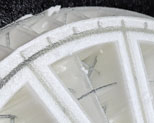
The radius, and therefore the focal length, of a given primary
mirror is less critical for a generic coma corrector used with
a paraboloidal primary mirror. However, primary mirrors that
vary by more than +/-0.125% in radius lead mass-market telescope
companies to build large adjustments into their sub assemblies.
This large adjustability of structures accounts for mass-market
opticians' inability to hit a radius tolerance. This usually
means the mirror mount structures are cantilevered and bend more
than if the mirrors all came in within a tighter tolerance, eliminating
the need for sub assemblies to move large amounts. |
|
|
|
Now that Dream has taken over all work to our lightweight primary
mirrors, we can finish the focal length to even tighter tolerances
than we were promised by outside opticians. Outside opticians
could never deliver on their promises and were often off by 0.8%
or more. Back then it forced Dream to customize each and every
telescope, one at a time, since our goal is high stiffness, to
provide high installed performance and repeatability. |
|
|
|
With our 2026 finishing developments we're able to achieve extremely
tight control over the focal length of these hyperboloidal primary
mirrors. This is a must when using this more optimized (hyper)
optical design, since it requires the mirror to be more narrowly
defined, as opposed to paraboloids. Details like this matter
because cutting corners in a half a dozen places, to maintain
a delivery-date-priority business, will produce soft installed
performance. There are no free lunches in optics... |
|
|
|
|
Each data set below is made
from ~1.45 million data points quantifying the optical surface,
tested in Dream's 5m vertical test tower, while on a carbon fiber
athermal mirror mount. |
|
|
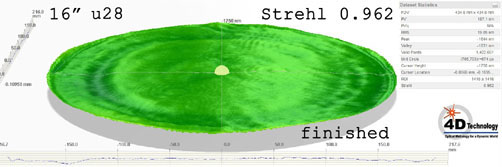 |
gen V: 1st |
finished
end of November, 2025.
|
Radius: too long by 0.24% initially, but reworked
to be long by 0.002%. |
|
|
|
|
|
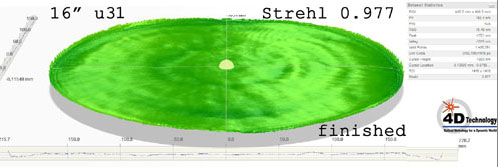 |
gen V: 2nd |
finished
March 3rd, 2026.
|
Radius: short by 0.0065%. |
|
|
|
|
|
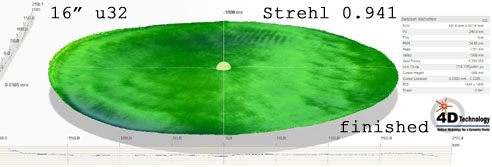 |
gen V: 3rd |
finished
March 29th, 2026.
|
|
|
|
|
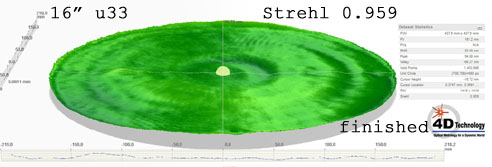 |
gen V: 4th |
"U33" (unit 33) came out of casting furnace
March 31st, 2026. It's now been cleaned out (upper left photo),
the back plano ground, face and back flange OD's edged and the
optical face fully ground to the correct face thickness and radius.
It finished polishing and is halfway through figuring as of April 19th, 2026.
U33 finished figuring April 24th, 2026
with a Strehl of 0.959 over the
entire 418.5mm optical surface. Over 406.4mm the Strehl is 0.967.
|
|
|
|
|
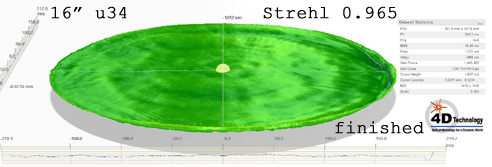 O O |
gen V: 5th |
Unit 34 came out of the casting furnace April
18th, 2026. It was cleaned out fully, then the back was
plano ground and edging started April 24th,
2026.
May 7th, 2026 u34 has gone through
all work prior to polishing and (at the end of grinding) is at
the desired radius.
U34 finished figuring May 24th, 2026
with a Strehl of 0.965 over the
entire 418mm optical surface. Over 406.4mm the Strehl is 0.976.
|
|
|
|
|
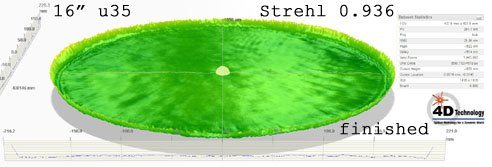 |
gen V: 6th |
Unit 35 finished casting and is shown to the left
during early cleanout on May 7th, 2026.
Unit 35 finished the last stages of fine grinding
May 25th, 2026. It started polishing
on the May 26th and was finished
with figuring on June 3rd, 2026. The Strehl is 0.936 over the full 418mm
optical surface (shown to the left), while over 406.4mm the Strehl
is 0.979.
|
|
|
|
 |
gen V: 7th |
August 3rd, 2026: Unit 36 is born. We're in
the process of fabricating 27 additional CFSC™ sub cells
for this telescope model. Three are used behind each primary
mirror (PM). We'll fully clean out, then process this u36 PM
when time allows.
|
|
|
October 2026
- Five of the lightweight primary mirrors will be coated this
month. |
|
|
|
Five additional (making 10 total) will be coated once
a few more are cast, processed and ready for coating. A future
update will announce this. |
|
|
|
|
|
|
|
|
|
|
|
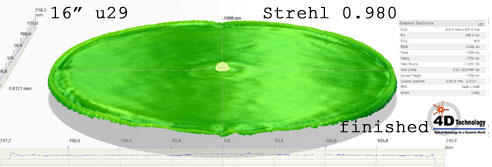 |
gen IV: 1 of 2 |
There will never be a gen III telescope because we're
skipping generations to move to more known/quantified (not
"qualified") optical surfaces. Only two gen IV's will
be made. The lightweight primary mirrors are paraboloidal instead
of the gen V's hyperboloidal, but these two gen IV primary mirrors
were also finished inside Dream. The gen IV's will use the original
4" coma corrector, but will use the new actuator-based focus
system of the Gen V's.
|
Radius: short by 0.0375%. |
|
|
|
|
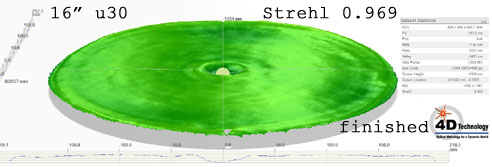 |
gen IV: 2 of 2 |
Both u29 and u30 data sets are showing the full (~418mm)
optical surface. Both of these data sets have just over 1.5 million
data points over the optical surface.
|
|
|
|
|
 |
|
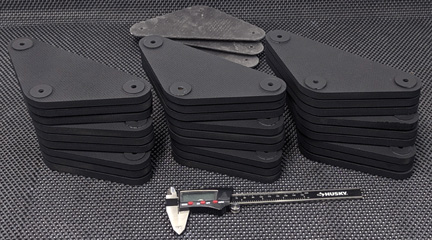
October 1st, 2026
- 30 athermal carbon fiber sandwich core (CFSC™)
sub cells are now finished and painted. This is enough for 10
16" primary mirrors. All carbon fiber is designed and fabricated
inside Dream. R&D for carbon fiber started in 2002, the year
before Dream was founded on paper.
Over the past month of time we have also been making
athermal CFSC™ main cells for
the 16" primary mirrors. A seventh unit was fabricatted
today and is in the oven baking under vacuum bag pressure right
now. Three additional units will be made over the coming weeks,
to give us 10 total units. |
|
|
|
|
|
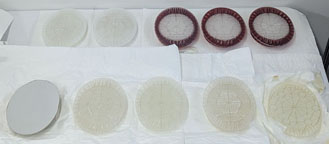
Below are 10 units of the 6" Dream
zeroDELTA™ lightweight
secondary mirrors used for this telescope. All 10 of the below
mirrors were here when Richard & Lew visited. At that
time the four uncoated mirrors in the bottom row (photo directly
below) were finished but uncoated. The five in the top row were
at different stages of grinding. We currently have less than
10 orders for this telescope design, but have already have two
additional 6" castings. |
|
|
 |
|
|
|
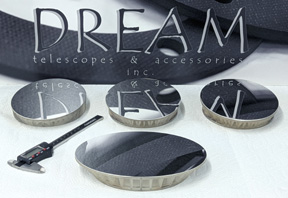
The four 6" uncoated lighweight secondary mirrors in the
bottom row above, came back from the coaters May
21st, 2026 and are shown below. |
|
|
 |
|
|
October 1st, 2026 - The five secondary mirrors in varying stages
of grind and shown in the top row of the photo to the left, have
now been finished. The finished mirrors are shown below, with
their red protective coating still on them. They will be cleaned
this week, then readied for going to the coaters. |
|
|
|

|
|
|
|
|
|
October 2nd, 2026 - The above mirrors are now cleaned and ready
for coating. The below five will be coated in October. Five 16"
hyperboloidal lightweight primary mirrors, for the first five
gen V 16" f3.5 Dream Hypergraph telescopes, will also be
coated in October. |
|
|

|
|
|
|
|
|
|
|
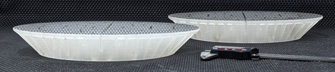
Both of Martin's mirrors finished final grinding August
8th, 2026 and are now finished, but need coating. Dream's contract to deliver
these two lightweight fold mirrors to Martin will not be late
until the third week of December, 2026. |
|

|
|
|
|
Martin's 8" mirrors: red protective
coating applied after grinding was completed, then the red was
removed after they were finished past spec: September
20th, 2026. They are waiting
to be coating in October. |
|
|
|
|
|
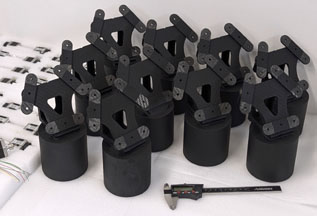
July 6th, 2026 - To the left are 10 athermal,
carbon fiber secondary mirror mount assemblies with integrated
tube hub that sits inside the spider hub. These hold Dream's
6" zeroDELTA™ lightweight secondary mirrors. These athermal
assemblies hold the mirror without distorting as temperature
changes (thermal) and offer extremely high stiffness (mechanical).
These characteristics are a key part of Dream's market-leading
all-sky installed performance. We currently have orders for 8
telescopes, so two of these sets are for future orders, although
we already have a fully built and painted 11th assembly that
isn't shown. |
|
|
|
|
|
 |
|
|
photo taken April
9th, 2026 |
|
|
|
|
|
|
|
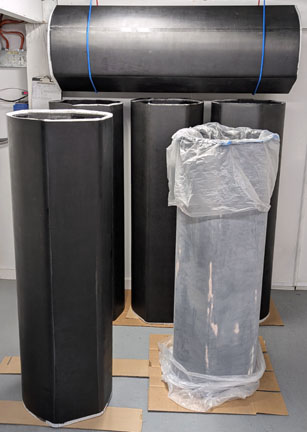
The photo to the left (taken April 9th,
2026) shows 5 new Dream HybridTube™ structures, with a 6th
existing tube in the foreground. Dream's unique tube has always
used 1" thick honeycomb, for maximum
stiffness, needed for this type of
telescope design. |
|
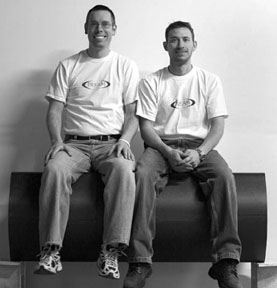
Below vintage photo illustrates
the high stiffness of this tube, with two of us (~360 pounds)
sitting on one tube with only the outer, bottom ends supported:
3-point bend "test." |
 |
|
vintage photo |
|
|
|
|
|
|
On
Friday, September 16th, 2022 the Royal
Observatory Greenwich announced their astrophotography winners. The mosaic image
to the
right is the Galaxy category winner, taken with a gen II 16"
f3.75 Dream Astrograph. |
|
|

|
|
|
The main reason this
image won the award was because the gen II Dream telescope captured
the faint remnants of a previous galactic collision that Sombrero
had in its past. |
|
|
9.58 hours; 275min L, 100min each RGB. |
|
|
|
|
|
|
|
|
|
|
"Hello Shane, I can't think of anyone who
has delved as deeply into the mechanics of telescopes as you." |
|
- Dream customer |
|
|
|
"I went to bed at
about 10PM and I let it run all night without focusing. I blinked
through the images and focus did not change. Also,
I did all of my other
images by letting
it run through the night without focusing." |
|
- Dream Astrograph owner |
|
|
 |
|
|
  |
|
Click on the photo to the left
to see why this telescope does not need clamshell/mounting rings.
A direct connection to the mount is superior because there is
less flexure and it gets the CoG of the telescope closer to the
mount - shorter lever arm means less bending and higher combined
system performance. |
|
|
The three links
below show completely raw, unprocessed individual test images
taken all-sky, without touching focus or collimation, with three
different gen II 16" f3.75 Dream Astrograph telescopes
while still here at Dream, using a luminance filter (400-700nm
bandpass). |
|
|
|
|
Click here
to see processed images taken with a gen II 16" f3.75 Dream
Astrograph. |
|
 |
|
|
|
"Within
a temperature range of 10°C we see no measurable change in
focus. Also, there was no change in focus as a function of telescope
position." |
- Michael Schwartz, Tenagra Observatories, 16" f3.75 Dream Astrograph
owner.  |
|
 |
|
|
|
M81/M82 image shows
the efficiency and quality of the original gen II 16"
f3.75 Dream Astrograph telescope. Image was taken in less
than one full night, with a front-illuminated CCD detector. |
|
16803 CCD detector: 9µm pixels, 4096
x 4096, 52mm image circle. |
|
Field Of View: 83.0' x 83.0' (1.9 deg²) |
|
Arc-seconds/pixel: 1.22 |
|
|
|
Dream's instruments are work horses
that operate at the highest level; today, tomorrow and ten
years from now. |
|
 |
One of Dream's gen II 16" f3.75 instruments (using
old 16801 detector) was one of
seven groups in a NASA NEO search
& recovery project and found more objects than all other
groups. At least one other group member was using a 1m telescope,
showing the extreme power, throughput & reliability of Dream's
philosophy of fully dealing with the traditional issues of low
stiffness & mirror
seeing. |
|
|
|
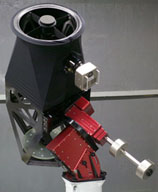
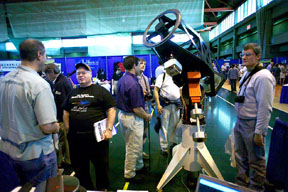
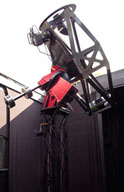
The history of this telescope
model - |
|
gen
0 |
 |
 |
  |
|
|
|
|
|
|
|
gen
I |
 |
 |
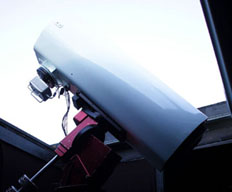 |
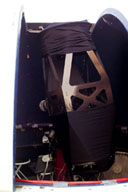
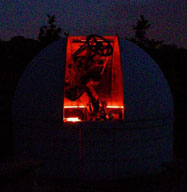
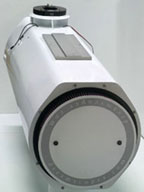
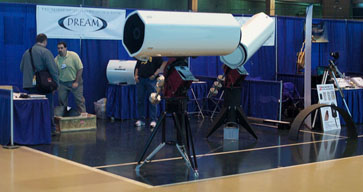
Abandoned years of work on the gen 0 open truss because
even with a black shroud the light leaks were horrible. A HybridTube™
profile mold was created and we switched to a sandwich core carbon
fiber tube using 1" thick honeycomb. This allowed us to
develop other complimentary technologies around the tube. |
|
|
|
|
|
|
gen
II |
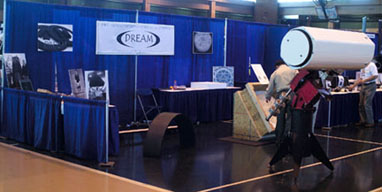
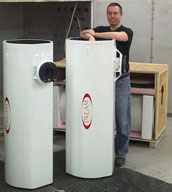 |
 |
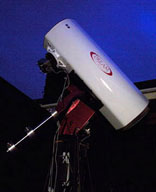 |
Focuser platform open ribs instead of closed, small
Dream logo on telescope and switched to lightweight mirrors for
both mirrors in the telescope. Last model that used a 3"
coma corrector. |
|
|
|
|
|
|
gen
II |
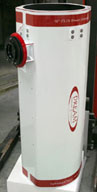 |
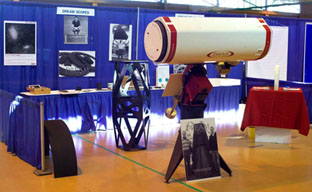 |
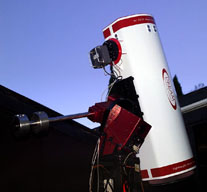 |
Switch to larger 4" coma corrector, slightly
larger logo and stripes added, but otherwise still lightweight
mirrors finished by outside vendors. |
|
|
|
|
|
|
gen
II |
|
|
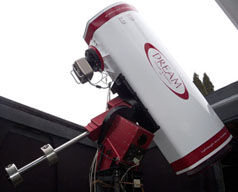 |
Larger Dream logo, continuous red stripe but otherwise
similar to above. Still used outside optician finished mirrors. |
|
|
|
|
|
|
|
gen
II |
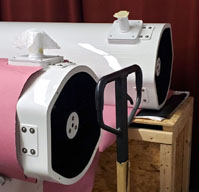
custom for US Air Force |
 |
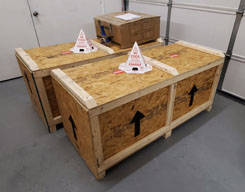 |
No logos, etc., because of what these are used for. |
|
|

|
|
Click either photo (left or
right) to watch a video about the interferometry technology developed
for JWST and funded by NASA. Dream uses this technology to finish
its world-class
lightweight mirrors in house. |
|
|
Click here
to see images taken with a 16" Dream Astrograph during test
out at Dream around 2010, then over 10 years later. |
|

|
|
|
 |
|
pricing, availability and
specifications subject to change without notice |
|
Copyright
© 2003-2026 Dream All Rights Reserved. |
|
Contact
Dream |

|
|
|
|
|
|
|
|
|
|
space domain awareness
(SDA), space Situational Awareness (SSA), Ball Aerospace, Lockheed
martin, Boeing space, Airbus defence & space, planewave instruments,
NASA JPL, NASA goddard, lightweight telescope, lightweight precision
optics, lightweight precision mirrors |